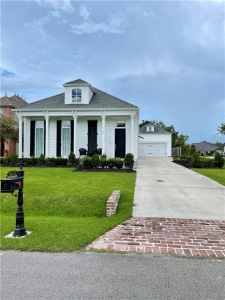
It is our goal at The Parks at Plaquemines to keep our buyers informed about the latest information from the local, state-level, and national real estate industry. We post content to our blog that we hope that you as our custom home buyer will find helpful. Look here for information about financing your new home, building restrictions for new homes, and real estate legislation that will impact you as you are looking to buy or build a new home in the Greater New Orleans area.

Will Supply-Chain Problems Affect Housing Affordability?

Although the hot market and buyer demand have pushed up home prices, the market still shows steady housing affordability. Even though home prices have risen, they are offset by the record low mortgage rates. According to reports, the housing market is not all smooth sailing. The ongoing supply-chain problems around the world have disrupted new construction and renovations.

The National Association of Home Builders/Wells Fargo Housing Opportunity Index (HOI) reported that 56.6% of both new and existing homes that were sold between July 2021 and September 2021 were affordable for U.S. families earning a median income of $79,900. This is the lowest affordability level since the first quarter of 2012!

The HOI also revealed that the U.S. national median home price rose to a record $355,000 in the third quarter. This is a rise of $5,000 from the second quarter of 2021 and a $35,000 increase from the first quarter of 2021. Buyers did not feel the rise because the average mortgage rates dropped by 14 basis points to 2.95% at the same time.

This is good news but there are some setbacks to the market. It has been hard to get materials and product is increasing in price at a fast pace.

“Persistent building material supply chain bottlenecks and tariffs on Canadian lumber and Chinese steel and aluminum continue to place upward pressure on construction costs and home prices,” said NAHB Chairman Chuck Fowke. “Policymakers must fix supply chain vulnerabilities that are disrupting and delaying construction projects and hurting housing affordability.”

“Interest rates are anticipated to gradually rise in the coming months as the Fed begins to taper its monthly bond and mortgage-backed securities purchases,” said NAHB Chief Economist Robert Dietz. “To keep affordability problems from worsening in the future, policymakers need to tackle supply-chain challenges that are hindering new home production. Helping builders boost output will also slow the rapid rise in home prices that has occurred over the past year.”

The five most affordable housing markets around the country currently are Lansing-East Lansing, MI, Pittsburgh, PA, Indianapolis-Carmel-Anderson, IN, Scranton-Wilkers-Barre-Hazleton, PA and Harrisburg-Carlisle, PA. The five least affordable major housing markets are Los Angeles-Long Beach-Glendale, CA, Anaheim-Santa Ana-Irvine, CA/San Francisco-Redwood City-South San Francisco, CA tied for second, San Diego-Carlsbad, CA and Oxnard-Thousand Oaks-Ventura, CA.

For the small housing markets, the five most affordable are Davenport-Moline-Rock Island, IA-ILL, Monroe, MI, Sierra Vista-Douglas, AZ, Fairbanks, AL and Wheeling, WV-OH. The least affordable small housing are Corvallis, OR, Salinas, CA, Napa, CA, Santa-Cruz-Watsonville, CA and San Luis Obispo-Paso Robles-Arroyo Grande, CA.

Click Here For the Source of the Information.

 

September’s State-Level Analysis on Employment

Thirty-three states and the District of Columbia saw a payroll employment increase in September compared to August. There was no change in Wisconsin and 16 states lost jobs during September. According to the Bureau of Labor Statistics, there was a 194,000 increase during September.

Broken down by states the top nonfarm employment month-over-month increase was the strongest in Texas with 95,800 jobs added, Florida with 84,500 jobs and California with 65,000 jobs. The biggest decrease was seen in Louisiana with 29,500 jobs lost which were part of the sixteen states with a total of 65,000 jobs lost across the country.

Year-over-year ending in September, 5.7 million jobs have been recovered marking the economic rebound from the COVID-19 pandemic induced recession.  All states and the District of Columbia added jobs. The highest was seen in California with 795,800 jobs added and the lowest was seen in Wyoming with only 1,700 jobs added.

The construction sector saw an increase in 30 states with 22,000 jobs added. This included both residential and nonresidential construction. Two states, Iowa and Kansas, saw no change while Texas add the highest with 8,900 construction jobs. Tennessee saw the biggest loss with 2,800 jobs gone.

Across the country, there was a 191,000 increase year-over-year with a 2.6% increase compared to September 2020. The largest gain was in California with 35,600 jobs while New York saw the largest decrease with 11,700 jobs lost.

As far as percentages reported, month-over-month saw an increase in Florida at 1.0% and a decrease in Lousiana of 1.6%. Year-over-year Hawaii saw an increase of 12.9% and Wyoming saw the smallest increase of 0.6%.

Click Here For the Source of the Information.

Tips To Take To Get a Higher Value on Your Home

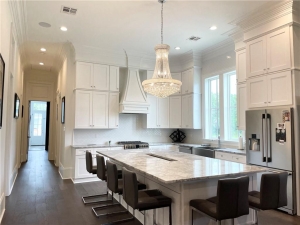
One of the first rooms a buyer looks at is the kitchen. The kitchen has become the heart of a home, and its functionality and appearance are important. This is the reason why kitchens are the most popular room for renovations. Remodeling a kitchen can be very expensive and a lot of work, but will add value to your home. Here are six tips to follow if you want to spruce up your current kitchen.
1. Paint or refinish your kitchen cabinets

This is a simple or cost-effective way to update your kitchen space. Outdated or dingy cabinets can harm a kitchen’s look. If you decide to change the color of your kitchen cabinets, make sure to choose a color that blends with the color scheme of your home. Another simple idea to update your outdated cabinets is to replace the hardware.

2. Add a kitchen island

Every buyer loves more counter space. A kitchen island not only gives extra counter space but storage as well. A kitchen island can drastically open up the room by offering depth and making more efficient use of the space. Kitchen islands not only are a great place to prep food but also can be a great place for additional seating. A nice kitchen island can cost upward of thousands depending on the size, materials, and accessories. If you are on a tight budget, a nice freestanding table can make a great kitchen island.

3. Install new energy-efficient appliances

Energy-efficient appliances are a great way to save energy and cut down costs on utilities. Switching your existing appliances to energy-efficient appliances is a great way to start. When purchasing new appliances look for the Energy Star label.

4. Consider updating your kitchen floor

Kitchen floors get the brunt of the mess in a kitchen. They take a beating from hot food spills, foot traffic, and appliances being moved across the floor. Replacing your old flooring can give your kitchen a facelift. Remember to choose durable and easy-to-clean flooring. Great materials include tile flooring, hardwoods, or artificial wood alternatives.

5. Install a backsplash

A backsplash behind an oven is a great way to protect from harsh spills and build-ups. It also makes it easier to clean them up. Having a backsplash above the kitchen countertops can add dimension and color to your kitchen.

6. Update lighting

Poor lighting in any space is a no-no. A kitchen can look very dingy with poor lighting. Try updating your lighting fixtures with energy-efficient LED bulbs. These will not only brighten up your kitchen but will also add to your energy savings. Adding track lighting and dimmers are another great idea to add ambiance to the space.

A major remodel or a minor remodel with both do wonders for your kitchen and adds value to your home. A Realtor can help you determine how much value can be added.

Click Here For the Source of the Information.

A Positive Employment Report for August

The NAHB Eye on Housing reported an increase in nonfarm payroll employment from July to August this year. Nonfarm payroll employment increased to 31 states in August with 235,000. This was at a slower rate than seen in July with an increase of 1,053,000.

August saw a strong increase on a month-over-month basis in California where 104,300 jobs were created, in Texas 39,300 and New York 23,500 were created. Nineteen of the states and the District of Columbia saw a decline with a loss of 64,100 jobs.

Out of the 48 states which reported construction sector job information, 24 of those states saw an increase in both residential and non-residential construction jobs. Colorado, South Dakota and Utah saw no changes while Nevada added 3,000 construction jobs. There was a 4.4% increase in New Hampshire but a 3.7% in Kansas between July and August.

The construction sector jobs also saw an increase of 2.7% by 193,000 jobs on a year-over-year basis. California again came in at the top with 35,900 construction sector jobs while New York lost the most at 11,700 jobs. In percentage comparisons, Rhode Island had the highest growth at 13.9 which Wyoming at the worst at a decline of 7.7%.

Click Here For the Source of the Information.

Patios Are Now Built on Over Half of New Homes

The National Association of Home Builders reported that over 60% of new homes built in 2020 have patios. This is the first time since the Census Bureau’s 2005 survey that patios have been on over 50% of new homes. There were around 990,000 single-family homes started in 2020 and 61.4% of these homes had patios.

The shares of new homes with patios started to dip in 2007 from 50.4% in 2006 to 48.8% in 2007. The shares did not begin on the upwards trend again until 2011. The big increase from 2019 at 59.6% to 2020 at 61.4% was due to buyers’ change in desires in what they want in a home. The pandemic caused us to rethink what is important when it comes to a home. Having a private place to spend outdoors became very important.

The nine US Census divisions also saw a drastic change across the board. Surprisingly the Mountain division was the highest at 74%, next was West South Central at 73%, the South Atlantic at 67%, and the Pacific at 59% all at over 50%. The remaining regions were all under 50% with the East North Central coming in at 47%, the West North Central and East South Central at 41%, New England at 21% and Middle Atlantic at 19%.

As for the construction and size of patios, those also differ. The majority of the patios across the board are constructed of poured concrete, followed closely by concrete and brick pavers. The average size across the board for a patio on a new single-family home was reported to be about 278 square feet. The largest were over 350 square feet in the Mid Atlantic, East North Central and Pacific divisions. The smallest which were under 200 square feet were found in the East South Central division.

Click Here For the Source of the Information.